Distributional's next chapter: Talaria Scientific
Distributional is now Talaria Scientific. Same company, same investors, hard pivot, new mission. This post is the honest version of how we got here and where we're going.
What we set out to do
We started Distributional in 2023 to solve AI testing for the enterprise: give teams a rigorous, repeatable way to know whether the AI systems they were shipping actually behaved the way they believed by using Bayesian statistical tests to detect non-stationarity and chaotic behavior. In late 2025 we sharpened that into behavioral analytics for AI agents in production, finding the patterns in raw trace data to find the evals that slipped through the cracks.
The vision landed, more than once. Enterprises took meetings and ran pilots, partners brought us opportunities, and inbound arrived steadily. The interest was real, but we never got the organic, in-production pull that separates a product from a promising idea. We had vision-market-fit more than once, but never turned it into product-market-fit while the market fundamentally changed underneath us.
What worked and what didn't
I still believe better AI testing is obvious and inevitable, but we failed to deliver the product the market needed at the time. The market always wins and being too early is the same as being wrong. Fundamentally, I think it broke down into three main issues. First, people don't like tests that slow them down, even (or especially!) if they don't write those tests themselves. People especially don't like complex, high dimensional statistical tests that are hard to interpret and take action on (you can't change the weights!). Finally, the market decided it would just YOLO AI systems into production anyway; a statistical gate between them and shipping was a hard sell. That last point was especially surprising to me after watching AI teams struggle to adopt basic ML models in my SigOpt days because random forests and gradient boosted decision trees were too exotic (how times have changed!).
I also believe that AI analytics is going to be an extremely important part of the stack. Analytics helps you find the evals that you don't know to look for by finding patterns in your unstructured logs. I think it is a core component of Maslow's hierarchy of observability, like any major category before AI, analytics helps you find the unknown unknowns that help make your product better over time. But it didn't work as a product for a different reason: it is a feature, not a product, let alone a startup. We were also selling from the top of the hierarchy while most of our buyers were still building the foundation underneath it. It was too easy for a monitoring product to box us out with simple analytics on top of their solutions, and most customers were just trying to stand up any agent, not improve them over time. Behavioral analytics is what you want once logging, tracing, and evals are in place, and much of the market wasn't there yet.
The decision
This spring we ran a thorough process to find the company a home. After thousands of hours of work we came close to a good outcome: serious diligence, term sheets on the table, and ultimately an acquihire offer for the whole team.
But none of those paths was better than the remaining one: a hard pivot. Keep the company, keep the balance sheet, and point everything we had learned at a problem where we have an unfair advantage.
Taking care of the team was extremely important to me and I'm proud that nearly the whole team received offers as part of our M&A search, and most are landing together at their next adventure. None of this part was easy, and the people involved handled it with professionalism and grace. I hope I can work with them again in the future.
Same company, new mountain
Talaria Scientific is a new product direction for the same Delaware corporation, Distributional, backed by the same investors. This is a change of mission, not a spinout or a new company. We're building a multi-agent harness for computational science: tooling that turns a 10x researcher into a 100x researcher, the way agentic coding did for software engineers over the last three years. You can read more about what we are building here.
I truly believe that the path to abundance via AI isn't in replacing white collar jobs, it is about new scientific discoveries that lead to things like new materials and more efficient energy which in turn lead to advances in medicine, aerospace, and more. It is about living in a scifi future and improving quality of life for everyone.
We can now meaningfully accelerate science with AI. And seen from far enough back, the new mission is the fourth incarnation of a process I have been on my entire career: make expensive computational work optimal, scalable, and trustworthy. Talaria takes that work one level deeper, from the tooling around the science to accelerating the science itself.
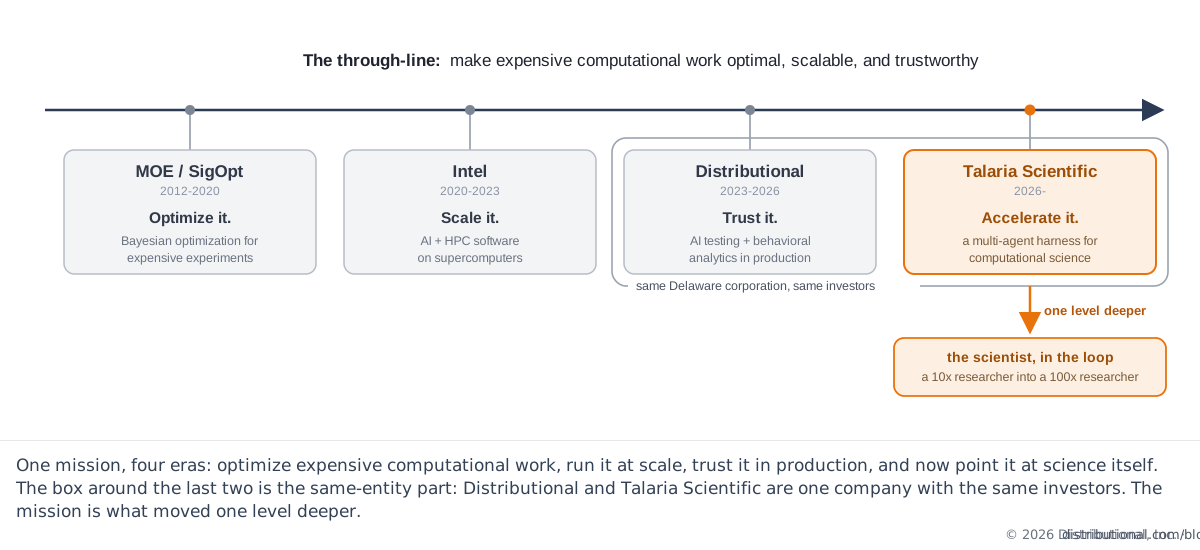
The slow, expensive part of research is the undifferentiated work in data wrangling, sysadmin, and validation. We aim to make that part fast, with the scientist in the loop and HPC as the guardrail. It's a mech suit for the researcher, not an android auto-scientist that replaces them. The product will be built in the open at talariasci.com and open source by NeurIPS 2026.
Why do I believe this one is different? I'm the target audience, so I can dogfood it on my own research and learn in days what enterprise sales cycles taught me in quarters. It sits on the parts of my background that are hardest to copy: optimization research, HPC, and the scar tissue from trying to optimize it all (ie building evals for the last 15+ years). And the need is real: researchers feel this pain every day, and the software world just spent three years proving the model for the SWE workflow.
What happens to this site
distributional.com stays up. The technical writing this team published deserves a stable home, so we're restoring a select blog archive at its original addresses over the coming weeks, and corporate updates like this one will land here when there's something real to say. Day to day, the building now happens at talariasci.com.
Thank you
To the team: you built something I remain proud of, and you handled the hardest parts of the last few years with grace. To our customers and partners: thank you for the trust and candor, especially the hard truths that led us to failing fast and getting to a better place. To our investors: thank you for continuing to believe and letting us continue to fight to make a difference in the world.
We set out to make AI trustworthy enough for serious work. I still think that's one of the defining problems of this era, and I suspect someone will crack the business of it. We're going to keep working on it one level deeper: making the harness that makes computational science trustworthy, and fast.
It's time to keep building. Semper Deinceps.
Scott